

Wan 2.7 Pricing: Plans, Free Tier, and Cost Per Video
Last month I was mid-project — six clips needed, deadline tight — and I genuinely had no idea how many credits I'd burned through or what the next generation would actually cost me. That's a terrible feeling when you're trying to quote a client or just stay on budget.
Hi, I'm Dora. I used to stress about this constantly. Back when I was stuck editing 1–2 videos a day, every wasted generation felt expensive. Now that I'm running 5–10 pieces of content daily, the math matters even more — just at a different scale.
So I sat down and actually mapped out how Wan 2.7 pricing works across platforms, what the free tier gives you, and where the real costs hit. This is what I wish someone had told me before I started.
Wan 2.7 Free Tier — What You Actually Get
Here's the first thing that tripped me up: Wan 2.7 itself doesn't have one single universal free tier. It depends on where you access the model.
On the official create.wan.video platform, new accounts receive a small credit allocation to test the system. Based on predecessor versions, that's typically enough for a handful of short clips — think 2–3 generations at 720p before you're looking at a paid plan. Resolution is capped on free tiers (usually 720p, not 1080p), queue priority is lower than paid users, and on some platforms, free-tier outputs carry watermarks.
On third-party API platforms like Atlas Cloud, the sign-up credit covers over 14 seconds of video generation — enough for at least one full-length clip and several shorter tests.
The important caveat: Wan 2.6 requires paid API access on some platforms, while Kling 3.0 offers 66 daily credits for free users. Whether Wan 2.7 follows the same API-access pattern or opens up a more generous free tier is something to confirm at the platform you're using. Don't assume.
Bottom line on free: enough to test prompts and check quality. Not enough to finish a real project.
Paid Plan Options
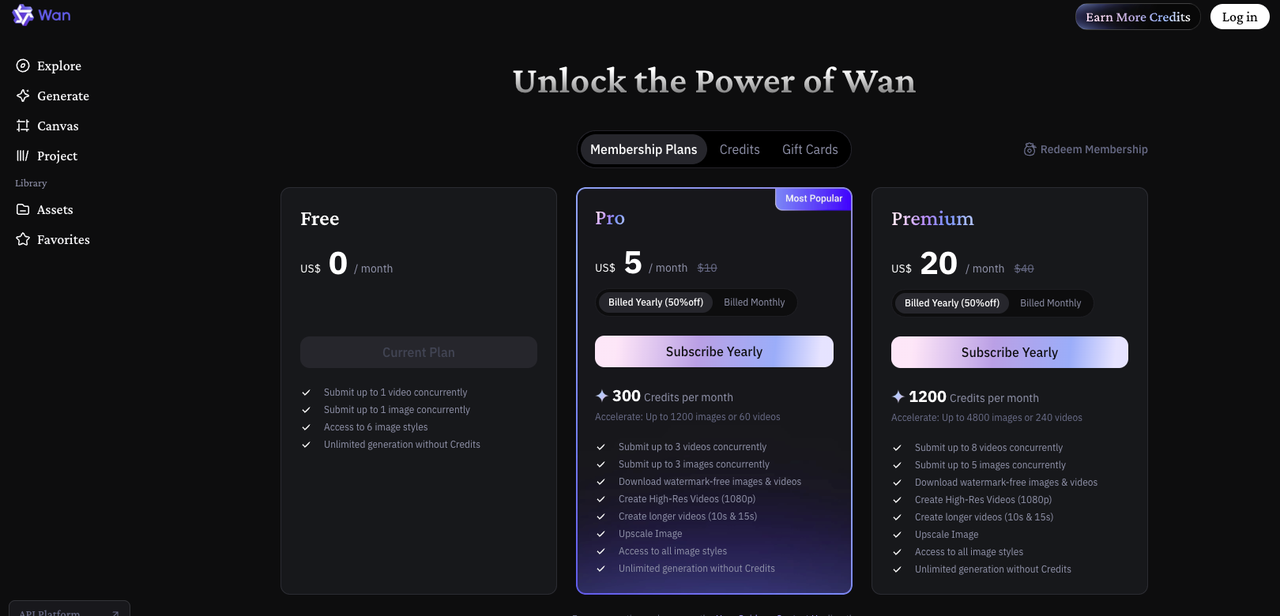
On the official Wan platform, paid membership plans run from Pro at $5/month (billed yearly, 300 credits/month) to Premium at $20/month (billed yearly, 1,200 credits/month). Those plans give you priority queue access and commercial use rights.
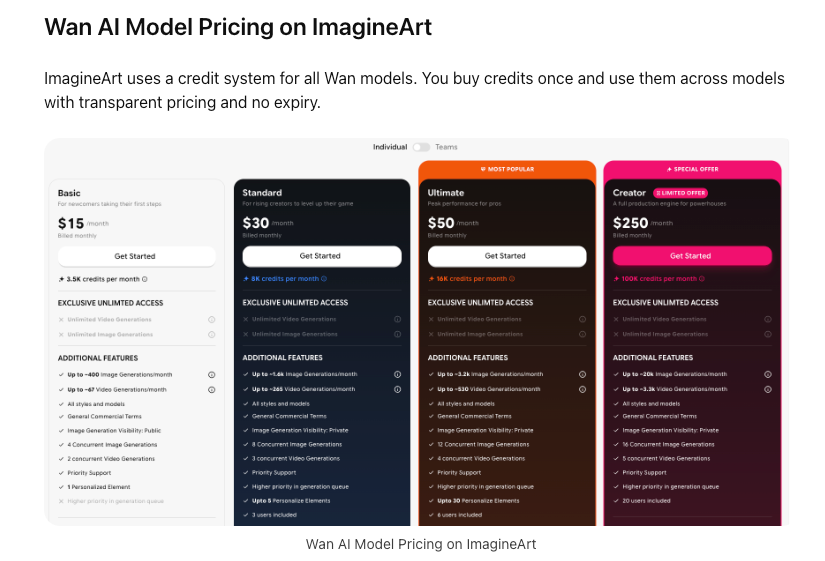
On third-party platforms, the structure shifts to pay-as-you-go or credit packs. PiAPI, for example, prices Wan 2.6 API access at $0.08/second for 720p and $0.12/second for 1080p T2V and I2V generation. Wan 2.7 rates will likely sit in a similar range, possibly slightly higher given the model's added capabilities — though official pricing hadn't been confirmed at the time of writing.
The key differences between tiers are: resolution ceiling (free = 720p, paid = 1080p), queue position (free users wait longer), and commercial licensing (critical if you're selling the content or using it for clients).
How Much Does a Video Actually Cost?
This is where you need to do real math, not just look at the monthly price.
A 60-second brand video typically breaks into 4–6 distinct clips at 10–15 seconds each. At roughly 12–18 credits per clip, a single clean pass runs 60–100 credits. Factor in 2–3 generation attempts per keeper, and the real budget per finished 60-second video sits at 75–150 credits.
Using the API route: on Atlas Cloud, Wan 2.6 is priced at $0.07 per second of generated video — a 5-second clip costs $0.35, and a 10-second clip costs $0.70. For Wan 2.7 with its expanded feature set, expect that to trend slightly higher.
The draft-first strategy is what saves me every time. Generate at 720p for concept testing, only upscale to 1080p for final delivery. You'll cut your cost per finished video significantly.
Wan 2.7 Cost vs Competitors
Here's the honest price comparison that nobody puts in a clean table:
Model | Approx. cost/sec | Max resolution | Max duration |
Wan 2.7 | ~$0.07–0.12 | 1080p | 15s |
Kling 3.0 | ~$0.084–0.126 | 4K | 15s |
Sora 2 | ~$0.15 | 1080p | 20s |
Seedance v1.5 Fast | ~$0.022 | 2K | 15s |
Veo 3.1 | ~$0.03 | HD | 8s |
Wan 2.6 is approximately 44% cheaper than Kling 3.0 and 53% cheaper than Sora 2 , and Wan 2.7 is expected to maintain that competitive cost position. Where Wan pulls ahead of the cheapest options like Seedance Fast and Veo 3.1 is feature depth — Wan 2.7 introduces first-and-last-frame control in a single clip, multi-image input via 9-grid layout, and natural language instruction editing on existing videos. That's not available at $0.03/sec anywhere.
Who Can Stay on the Free Plan?
Honestly? A pretty specific type of creator.
If you're in testing mode — evaluating whether Wan 2.7 fits your workflow before committing — the free tier does its job. You can check motion consistency, test how your prompts land, and see whether the 9-grid I2V feature works for your reference images. That's real value.
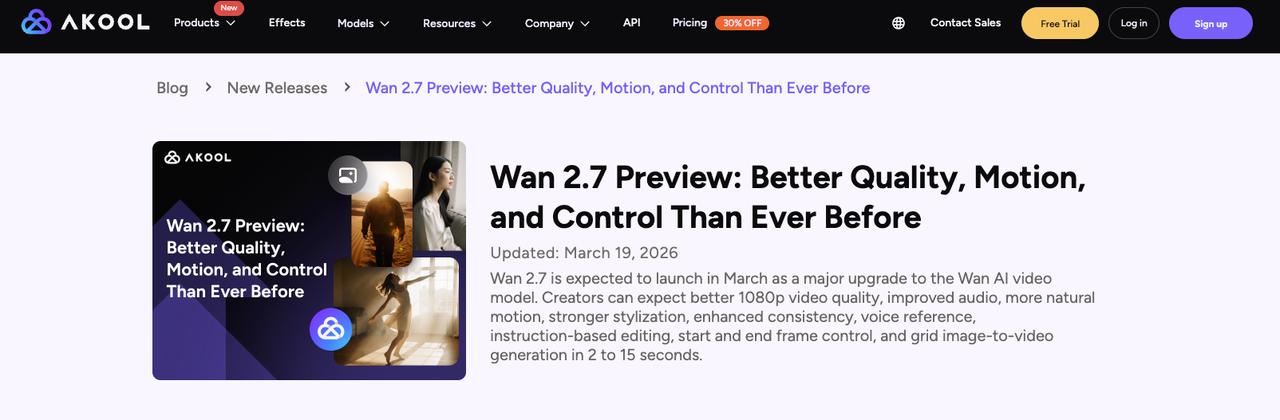
If you're uploading 5–10 videos per day, the free tier runs out within your first generation session. This isn't a complaint — it's just math. Wan 2.7 supports video durations from 2 to 15 seconds with 1080p resolution output. At that quality level, the compute cost is real and someone has to cover it.
The free plan also comes with the watermark question. On most platforms, free-tier outputs are either watermarked or listed as public demos. If you're posting to a client account or your own brand channel, that's a problem.
When to Upgrade
My rough rule: if you're generating more than 10 clips per week, a paid plan pays for itself in reduced friction alone — no queue waiting, no watermark removal step, no hitting a wall mid-project.
The clearer signals to upgrade:
You have a commercial project. Free tiers almost never include commercial rights. Check the license terms before you post anything.
You need 1080p output. The quality difference is visible, especially on anything larger than a phone screen.
You're using new Wan 2.7 features. Wan 2.7 uses a credits-based model where credits do not expire — unlike most AI video tools that reset unused capacity at month end. If you work project-to-project rather than daily, this structure is actually more practical than a subscription.
You're building a repeatable content workflow. The Wan model GitHub is the fastest place to track open-weight releases if you're considering self-hosting for volume.
FAQ
Q: Is there a Wan 2.7 free trial?
A: Yes, though the exact credit amount varies by platform. The official create.wan.video platform offers a small free credit allocation for new accounts. Third-party API platforms like Atlas Cloud offer signup credits as well. Expect enough for a few test generations — not a full project.
Q: Does the free plan allow commercial use?
A: Generally not. Commercial license is typically included only in paid plans , not the free tier. Always check the specific terms of the platform you're using before distributing outputs commercially.
Q: How is Wan 2.7 billed — by second or by credit?
A: Both models exist depending on where you access them. The Wan model series has typically been billed per-second or per-video through DashScope. On third-party platforms, a credit-to-second conversion system is more common (e.g., 10 credits = 1 second of video).
Q: Are new features like 9-grid I2V available on free plans?
A: This varies by platform and is still being confirmed as Wan 2.7 rolls out across providers. Based on historical patterns with previous Wan versions, advanced features tend to be paid-tier only. Worth testing on your platform of choice, but don't count on it for free.
Q: How does Wan 2.7 pricing compare to Kling's free tier?
A: Kling 3.0 offers 66 daily credits for free users , which is a notably more generous free tier than what Wan 2.7 currently offers through most access points. If free daily generation matters to your workflow, Kling has the edge there. Wan 2.7 competes on feature depth and cost-per-second on paid plans.
The real answer to "how much does Wan 2.7 cost" is: it depends on your volume and where you run it. For casual creators, the free tier or a $5–$20/month plan covers most use cases. For production workflows, the per-second API math matters more than the sticker price. Run the numbers for your actual clip count before you commit to any plan — and keep an eye on the Alibaba Cloud Model Studio page for official Wan 2.7 rate updates as they go live.
Previous posts: