

Wan 2.7 vs Wan 2.6: Which Should You Use in 2026?
Long time no see. I'm Dora. Let me be honest: I almost wrote a different article.
I was going to wait until Wan 2.7 officially dropped before comparing the two. But the more I dug into the gap between what 2.6 can do today and what 2.7 is promising, the more I realized creators are making real decisions right now — and they need actual information, not "check back later."
So here's what I know, what I've tested, and where I'd put my workflow money depending on what you're building.

Wan 2.6 vs Wan 2.7 — Side-by-Side Overview
Before getting into the workflow details, let me lay out the core differences in a table. This is the version of the comparison I wish I'd found when I started researching.
Feature | Wan 2.6 | Wan 2.7 |
Max video duration | 15 seconds | 15 seconds (same) |
I2V mode | Yes — image-to-video with character consistency | Yes — improved I2V with enhanced photorealism |
Editing mode | Prompt-based generation only | Natural language instruction editing (new) |
Video recreation | Not supported | Supported — restyle or swap subjects from existing video |
Output resolution | 720p / 1080p | Expected 720p / 1080p, improved detail accuracy |
Reference inputs | Up to 3 reference videos (@Video1, @Video2, @Video3 syntax) | Up to 3 references + audio reference capability |
Audio sync | Yes — native lip sync and speech alignment | Enhanced audio, better temporal sync |
Motion quality | Smooth, physically plausible for most scenes | Smoother, more temporal consistency across frames |
Access channels | fal.ai, WaveSpeed, SeaArt, ComfyUI (WanVideoWrapper) | Planned: WaveSpeed, API access (timeline: late March 2026) |
Open source weights | Available (Apache 2.0, via HuggingFace) | Not yet released publicly |
The key things to note: Wan 2.7 brings significant improvements across five core areas — visual quality, audio, motion dynamics, and two new editing capabilities that 2.6 simply doesn't have. But 2.6 is mature, widely deployed, and already deeply integrated into the workflows a lot of creators rely on daily.

What Wan 2.7 Adds That Wan 2.6 Doesn't Have
Here's where things actually get interesting. These aren't incremental tweaks — they change what the model can do in a workflow.
Natural language video editing. This is the one I keep coming back to. With Wan 2.7, you can edit existing videos using natural language instructions — change the background, modify lighting, or alter a character's outfit by just describing the change. In 2.6, if you want to change something, you're regenerating from scratch. That's the difference between a five-second text command and a five-minute regeneration loop.
Video recreation. You can recreate or replicate existing videos with modifications — changing style, swapping subjects, or adapting content for different contexts while preserving the original motion and structure. This matters enormously for brands that want to repurpose existing footage without reshooting, and for creators doing format remixes.
Sharper visual quality across the board. Expect sharper, more detailed, and more photorealistic outputs with better color accuracy and fine-grained detail preservation. I've seen early test comparisons and the skin tone and texture detail difference is visible — not subtle.
Better motion dynamics. Smoother, more physically plausible motion with better temporal consistency across frames. If you've run into 2.6's occasional jitter on fast motion or complex multi-character scenes, 2.7 appears to address this at the architecture level.
What this adds up to: Wan 2.7 isn't just a better video generator — it's evolving into a full video creation and editing toolkit. That's a different category of tool than 2.6, which is purely generative.
Where Wan 2.6 Still Holds Its Own
I'd be doing you a disservice if I just hyped 2.7 without being honest about where 2.6 is genuinely mature and reliable.
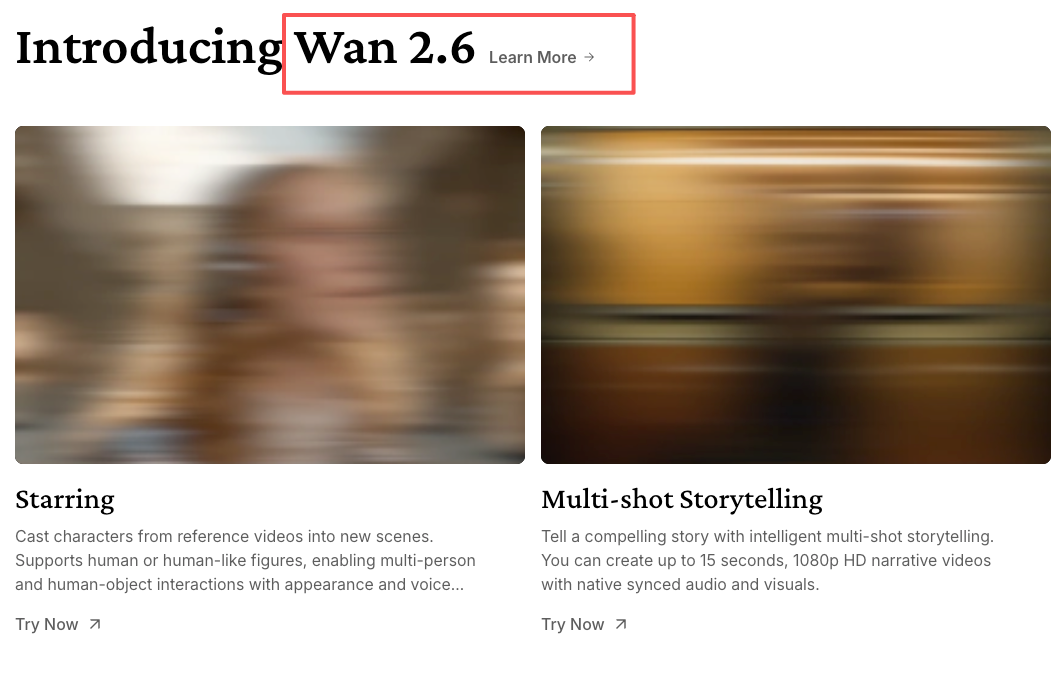
Multi-shot storytelling is already solid. Wan 2.6 transforms a single image into multi-scene narratives with proper transitions when using prompt expansion and the multi_shots parameter. This works reliably today, it's well-documented, and the community has built significant workflow knowledge around it.
Character consistency at 3-reference depth. Wan 2.6 supports up to 150 reference frames for appearance and audio consistency, preserving facial structure, skin tone, hair style, clothing details, body proportions, and voice characteristics — and for multi-character scenes, it handles up to three simultaneous references. That's production-grade identity preservation that's available now.
Aspect ratio coverage is already complete. Wan 2.6 expands aspect ratio coverage to match platform-specific requirements — 16:9, 9:16, 1:1, 4:3, and 3:4 — eliminating post-generation cropping when targeting YouTube, Instagram Reels, or square social formats.
ComfyUI integration is mature. Wan 2.6 has stable custom nodes, documented workflows, and an active community of people who've already solved the edge cases. When I'm running 20 clips in a batch session, I want reliability over novelty. 2.6 gives me that. You can check the official Wan 2.2 GitHub repository to understand the underlying architecture that Wan 2.6 builds on — it helps put the model's capabilities in context.
Pricing parity on most platforms. Wan 2.6 costs 300 credits per video on ImagineArt — the same as Wan 2.5 — providing enhanced audio, flexible durations of 5–15 seconds, and 720p or 1080p resolution. You're not paying a premium to access current 2.6 capabilities.
Who Should Wait for Wan 2.7
Solo Short-Form Creators
If you're doing high-frequency short-form content where the bottleneck is iteration speed, the natural language editing in 2.7 could cut your revision time significantly. Right now with 2.6, a lighting change means a full regeneration. With 2.7, you describe the change and wait 30 seconds. For creators doing 5–10 clips daily, that compounds fast.
Brand & Marketing Teams
The video recreation feature is where brand teams should pay close attention. Repurposing existing campaign footage — changing backgrounds, seasonal elements, or regional visual styles — without reshooting is a meaningful workflow unlock. Together, the improvements and new features point to a more comprehensive creative workflow that takes creators from concept to finished video with far less friction. For teams managing multiple campaigns and markets, this matters.
Product Video & E-Commerce Creators
Photorealism improvements hit hardest here. Product demos need accurate material rendering — fabric texture, surface reflection, packaging detail. If 2.7 delivers on its promise of better color accuracy and fine-grained detail preservation, product creators will notice it immediately in the output quality. For a practical sense of what the Wan model family can produce for product content, fal.ai's model comparison documentation gives a grounded benchmark.
Who Can Stick With Wan 2.6 for Now
If you need something today. Wan 2.7 is expected late March 2026 at the earliest. As of March 2026, Wan 2.2 remains the latest version with publicly available weights for self-deployment. The same applies to Wan 2.6 in the hosted ecosystem — it's available, stable, and well-documented. If you have a project deadline this month, 2.6 is your model.
If ComfyUI is your primary environment. Wan 2.2 received Day-0 native support in ComfyUI at launch under the Apache 2.0 license, enabling commercial use. Wan 2.6 followed a similar pattern. With 2.7, you'll likely wait a few weeks post-launch for stable ComfyUI nodes and community workflows to mature. If you're deep in a ComfyUI pipeline, switching mid-project for an unvetted node setup is a real risk.
If your content is under 10 seconds. Most TikTok and Instagram content fits inside what 2.6 already handles well. Videos under 10 seconds — most social media content — fit within the range that 2.6 handles; for high-volume work, generation speed and stability matter more than cutting-edge features.
If you're still learning the model. Everything you learn with 2.6 — prompt structuring, reference input workflows, aspect ratio settings, motion parameters — carries forward. Starting with 2.7 before you understand the fundamentals means debugging two variables at once.
FAQ
Is Wan 2.7 backward compatible with 2.6 workflows? Based on the upgrade pattern between Wan 2.5 and 2.6, API parameter structures are likely to remain similar with additive new parameters rather than breaking changes. That said, the new editing endpoints for 2.7 will be new additions. Existing text-to-video and image-to-video workflows should migrate with endpoint updates, not full rewrites. Verify with the official Wan documentation before migrating production pipelines.
Will Wan 2.7 be free like 2.6? Wan 2.6 open-source weights are available under Apache 2.0 for self-deployment — free if you're running your own hardware. Hosted access via platforms like fal.ai and WaveSpeed uses credit-based pricing. Wan 2.7 will likely follow the same pattern: open weights eventually, credit-based access on hosted platforms. Early access during launch windows sometimes comes with promotional pricing.
Which has better motion consistency? Wan 2.7 explicitly improves motion dynamics — smoother, more physically plausible motion with better temporal consistency across frames. Wan 2.6 is already solid for most scenes, but complex fast motion and multi-character interaction can produce occasional jitter. If motion consistency is your biggest current pain point with 2.6, 2.7 addresses it.
Does Wan 2.7 support ComfyUI? Not officially at time of writing. The pattern from Wan 2.2's Day-0 ComfyUI support — where native integration arrived immediately at launch — suggests Wan 2.7 may follow the same path. But community node development for new features (especially the editing pipeline) will take additional weeks to stabilize.
Should I wait for Wan 2.7 or start with Wan 2.6 now? Start with 2.6 now unless you specifically need natural language editing or video recreation — the two features that 2.6 genuinely doesn't have. The skills transfer completely, the community support is mature, and the model is stable. A few weeks of practice with 2.6 will make you a more effective user of 2.7 when it arrives.
Which to Use — The Short Answer
Use Wan 2.6 if: You have current projects, you're working in ComfyUI, your content is under 10 seconds, or you're still building fluency with the model.
Wait for Wan 2.7 if: Natural language editing would change your workflow, you need video recreation for repurposing campaigns, or photorealism quality is a hard requirement.
Hybrid approach (what I'm doing): Finishing current projects in 2.6, building the same workflows I'd run in 2.7, and planning to migrate once the ComfyUI nodes are stable and a few weeks of community testing have surfaced the edge cases. For deeper technical workflow context, Spheron's deployment guide for Wan models is worth reading before you plan any production pipeline migration.
I'm not in a rush. The best version of any model is the one that has a stable community around it and enough documentation to debug when things go wrong. Wan 2.6 has that today. Wan 2.7 will have it eventually.
Worth the wait — but don't stop creating in the meantime.
Previous Posts:
Explore Runway alternatives to find efficient AI video tools
Check out the 2026 best AI video generators to quickly pick the right tool
Compare AI agents versus traditional video generators to find the best automation approach
Discover AI video editing workflows in 2026 to boost batch production efficiency
Learn how to automate your video workflow with AI agents for maximum efficiency