

MiniMax Music 2.6 Pricing: Is It Free for Commercial Use? (2026)
I've spent $180 on AI music tool subscriptions in a single year. Combined savings: maybe 20 minutes. That math is what pushed me to actually read the fine print before spending on anything new.
So when MiniMax Music 2.6 dropped and people started calling it "free for commercial use," I didn't just believe it. I went to the pricing page myself, mapped out the credit costs, and compared them against what I actually spend on Epidemic Sound every month. Here's what I found — including the part the marketing doesn't lead with.
MiniMax Music 2.6 Pricing: Free vs. Paid Breakdown
What you get for free (credits, track length, generation limits)
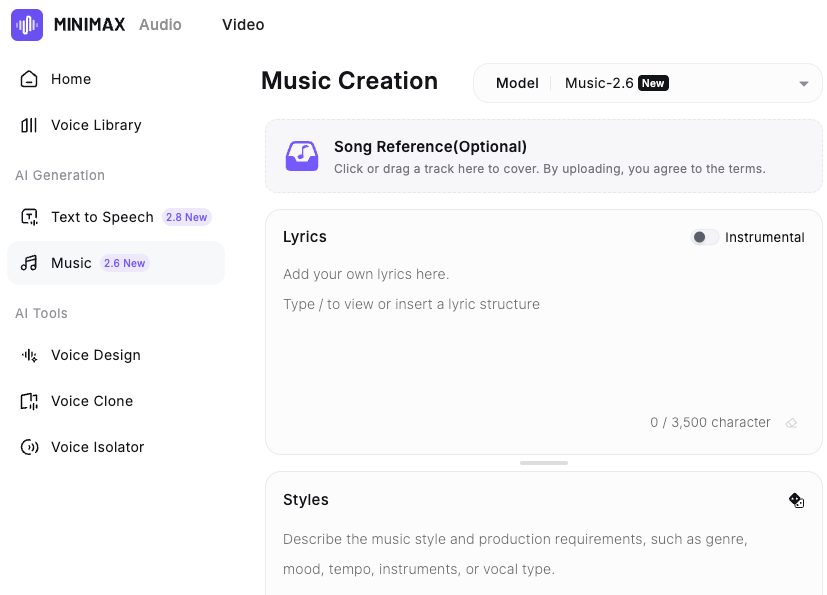
There is no permanent free tier. What new accounts receive right now is a limited-time 14-day global creative beta (announced April 10, 2026 on the official MiniMax blog). During this beta, consumer users get 500 free creations per account per day. Once the 14-day beta ends, you move to the paid one-time credit system.
“Free” therefore means “free to test at high volume for two weeks.” If you’re evaluating for ongoing production use, budget for paid credits from day one and treat the beta as a generous test run, not a forever plan.
Generation cost (verified) Each full song generation with Music 2.6 costs 4 credits, regardless of track length (up to 4 minutes), complexity, vocals, or use of new features like Lyrics Optimizer. No hidden multipliers.
Paid tiers — what unlocks and at what cost
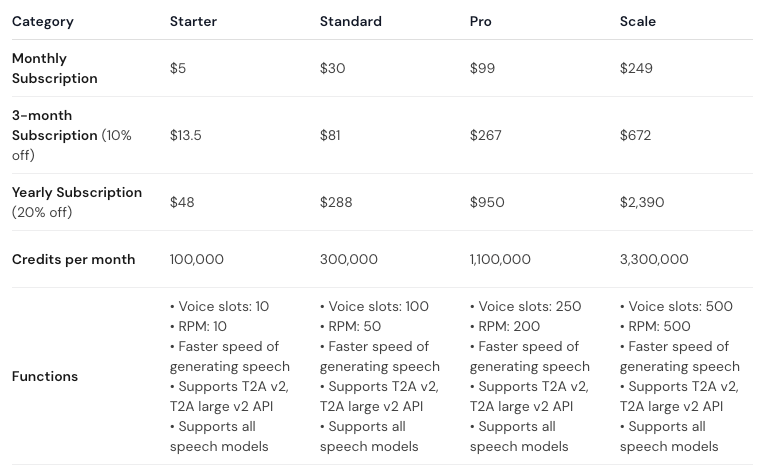
The MiniMax Music 2.6 pricing page runs on a one-time credit purchase model, not a subscription. Four tiers:
Plan | Price | Credits | Bonus | Total Credits | Effective cost per track (4 credits/song) |
Basic | $9.90 | 120 | 0 | 120 | ~$0.33 |
Advanced | $29.90 | 375 | 40 | 415 | ~$0.32 |
Pro | $59.90 | 788 | 189 | 977 | ~$0.306 |
Premium | $89.90 | 1,266 | 398 | 1,664 | ~$0.284 |
Credits never expire. No subscription lock-in. No re-authorization required when you cancel — there's nothing to cancel. You buy when you need, and the credits sit there.
For high-frequency creators doing 5–10 videos per day, that math gets interesting quickly. At roughly $0.08 per track, 30 tracks per month runs you about $2.40. That's not a typo.
Commercial Use: What You Can and Can't Do
Using AI music in monetized YouTube and TikTok videos
According to the MiniMax Music 2.6 feature page, all music generated through the platform is royalty-free and cleared for commercial use — YouTube videos, TikTok, podcasts, game soundtracks, advertisements, and branded content. No attribution required. No additional licensing step.
I went in pretty skeptical about this. "Royalty-free" gets thrown around loosely, and some platforms say commercial use but quietly carve out paid ad placements in the fine print. The MiniMax terms don't carve that out — ads are explicitly listed as covered use cases.
For YouTube: no Content ID issues from MiniMax itself, since the music is generated fresh and doesn't match any registered fingerprints in copyright databases. The risk on YouTube isn't MiniMax — it's if you use a copyrighted melody reference that somehow influences the output. For original prompts, you're clean.
For TikTok: TikTok's copyright detection has gotten significantly more aggressive in 2026, especially for business accounts running ads. AI-generated original music avoids the fingerprint problem entirely, which is exactly why some creators are moving toward AI music generation over library tracks. Original audio = no existing fingerprint to match.
Using in paid client projects or brand ads
This is the one area where I'd still recommend verifying directly with MiniMax support before committing to a large client project. The platform's public language covers commercial use broadly, including "branded content" and "advertisements." But for agency-scale work where a client might ask for written IP clearance documentation, you'll want something more formal than a website FAQ.
For solo creators running their own channels or product videos? The commercial use coverage is clear enough for practical purposes.
Attribution requirements (if any)
None. You don't need to credit MiniMax in your video description, the audio track, or anywhere else. Generate it, download it, use it.
How It Compares to Stock Music Licensing Costs
Cost-per-track comparison with Epidemic Sound, Artlist, and free libraries
Let's be honest about what stock music actually costs when you run the numbers.
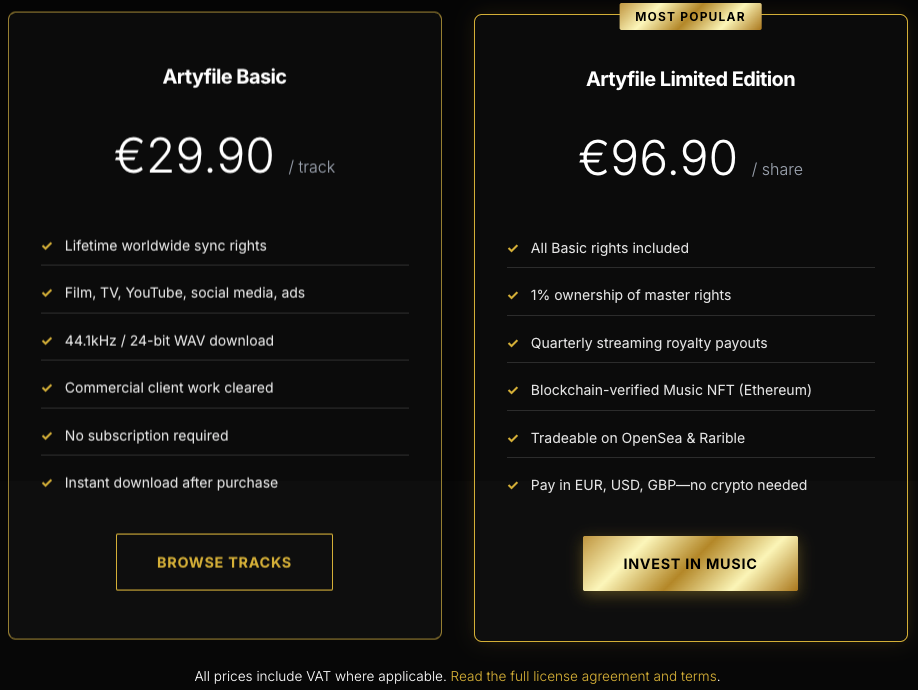
Both Artlist and Epidemic Sound start at around $9.99/month with annual billing cchound — but that's the personal plan. The commercial plan, which you need for brand content and monetized videos, runs higher. Epidemic Sound's commercial plan sits at $49/month, and Artlist's commercial tier is around $16.60/month on an annual plan Artyfile.
At Epidemic Sound's commercial rate, you're paying $588/year for unlimited access to tracks you can use in client work. Sounds reasonable until you think about what happens if you cancel — projects published during your subscription retain rights, but you cannot use tracks in new projects after canceling, which means resubscribing Artyfile. It's a right cliff. MiniMax credits don't expire and don't have this problem.
Free libraries like YouTube Audio Library and Pixabay Music exist, but quality and selection are inconsistent. More importantly, selection is fixed — you're choosing from what exists, not generating something that matches your exact mood and tempo.
Source | Monthly cost (commercial) | Cost per unique track | Rights after canceling |
MiniMax Music 2.6 | ~$2–5 (pay-per-use) | ~$0.07–0.08 | Permanent |
Epidemic Sound | $49/mo | Included in sub | Lost for new projects |
Artlist | ~$16.60/mo | Included in sub | Lost for new projects |
Free libraries | $0 | $0 | Permanent (attribution may apply) |
Time saved vs. manual licensing across a month of content
Here's something worth thinking about that doesn't show up in the cost comparison: licensing search time. Finding the right track on Epidemic Sound for a specific video takes me anywhere from 8 to 25 minutes, depending on how specific the mood is. At 30 videos per month, that's 4–12 hours of licensing work.
With MiniMax, the prompt-to-track process takes under 2 minutes. That detail alone earned it a permanent spot in my workflow testing.
Who Should Pay and Who Can Stay on Free
Solo creator on a tight budget (Persona A)
If you're producing content for your own channels, not running paid ads, and making fewer than 50 videos per month — the trial credits might genuinely last you a few weeks. When they run out, the Basic tier at $9.90 for 120 tracks is a real option. That's four months of background music for a creator doing 1 video per day.
Worth trying if you're producing at this volume. If you're not, skip it.
Brand team producing 20+ videos per month (Persona B)
The Pro or Premium tier makes more sense here. At 20+ videos per month, you need consistent audio quality and you can't spend time hunting tracks. The Pro tier at $59.90 for 788 credits gives you 13+ months of music at 1 track per video, with no subscription to manage. The one-time structure actually works in your favor here — no surprise renewals, no quarterly reviews of whether the subscription is still "worth it."
This is the one I'm still testing for a client workflow. Week 4 and I'm not bored of it — that's rare.
E-commerce seller running product video ads (Persona C)
This is where MiniMax Music 2.6's commercial ad coverage matters most. TikTok's copyright detection bots are smarter than ever in 2026, and they can instantly mute commercial content that uses unlicensed tracks TikAdSuite — which doesn't just kill reach, it can flag your ad account. AI-generated original audio sidesteps the fingerprint problem entirely.
For e-commerce teams doing product video ads at volume, the math works easily. Budget $30–60 one time, generate 375–788 tracks, use them across your ad creative tests. No rights cliff, no re-licensing per platform, no renewal decision at the end of the year.
FAQ
Q: Is MiniMax Music 2.6 completely free? Not permanently. New accounts get trial credits, but there's no ongoing free tier. Once trial credits are exhausted, you're on the paid credit purchase model.
Q: What's different between Music 2.6 and Music 2.5? MiniMax Music 2.6 was released on April 10, 2026 and added two capabilities not in 2.5: AI Cover mode (transform an existing song into a new style while preserving its melody) and Lyrics Optimizer (auto-generate lyrics from a style prompt). Generation speed is also noticeably faster. The pricing structure between versions is effectively the same — the credit system stayed consistent.
Q: How many tracks can I generate per month? There's no monthly cap. Credits never expire and you generate tracks as needed. The Advanced plan's 375 credits could cover 375 videos, used over any timeframe.
So What's the Bottom Line?
For most creators producing short-form content at volume, MiniMax Music 2.6 is genuinely worth trying before committing to another stock music subscription. The cost per track is low, credits don't expire, and the commercial use coverage is clear for standard creator and brand use cases.
The one thing I'd flag: if you need formal written IP clearance for a large client contract, follow up with MiniMax support directly. The platform language is solid for individual creator use. For agency-scale deliverables where a client's legal team gets involved, get it in writing.
For everyone else — the $29.90 Advanced tier is probably the right test. 375 tracks. No expiration. See if it fits your workflow before deciding whether to scale up.
Previous Posts: